

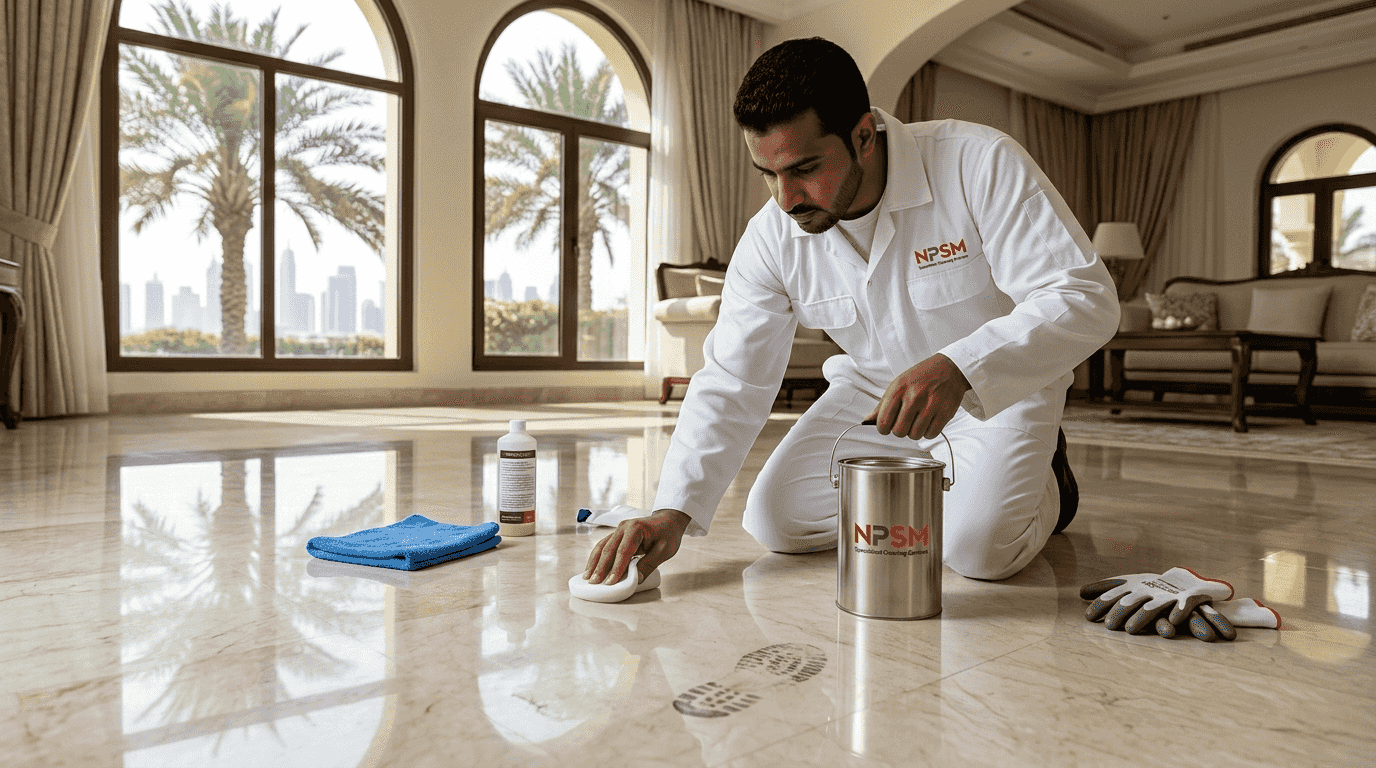

Many villa owners in Dubai worry that chemical floor polishing damages their expensive marble, granite, or wooden floors. This guide clarifies how chemical polishing safely restores and protects luxury floors in Dubai’s harsh climate. You’ll learn the science behind chemical treatments, why they outperform mechanical methods, and how to choose qualified professionals for your home.
Table of Contents
- Introduction To Chemical Floor Polishing
- How Chemical Floor Polishing Works
- Advantages Over Mechanical Polishing
- Common Misconceptions About Chemical Floor Polishing
- Maintenance Frequency And Scheduling For Dubai Floors
- Choosing The Right Professional Chemical Floor Polishing Service In Dubai
- Summary And Next Steps
- Professional Chemical Floor Polishing Services In Dubai
- What Is Chemical Floor Polishing And How Does It Work?
Key takeaways
| Point | Details |
|---|---|
| Chemical restoration process | Chemical floor polishing uses specialized agents to restore marble, granite, and wood floors by removing oxidation and sealing surfaces. |
| Superior to mechanical methods | Chemical treatments remove microscopic damage, save time, and extend maintenance intervals compared to abrasive mechanical polishing. |
| Professional application essential | Over 25% of floor damage cases result from DIY attempts, making certified professionals crucial for safe application. |
| Climate-specific maintenance | Dubai’s coastal humidity and sand exposure require marble polishing every 2-3 years, granite every 2 years, and wood treatments yearly. |
| Service selection criteria | Verify certifications, chemical safety standards, customized assessments, and transparent damage mitigation procedures before hiring. |
Introduction to chemical floor polishing
Chemical floor polishing uses specialized chemical agents to restore and protect marble, granite, and wooden floors at the molecular level. Unlike mechanical buffing that physically abrades surfaces, chemical treatments dissolve oxidation, fill micro-scratches, and create protective barriers. This process is particularly vital for floor polishing services in Dubai because the coastal environment accelerates floor deterioration.
Dubai’s unique climate presents specific challenges for luxury flooring. High humidity causes marble to absorb moisture, leading to surface cloudiness. Airborne sand particles act as constant abrasives, creating microscopic scratches that dull granite and wood surfaces. Salt from the nearby Arabian Gulf penetrates porous stone, causing discoloration over time.
Luxury villas and apartments depend on pristine floors to maintain property value and aesthetic appeal. Research shows that well-maintained floors can increase property valuations by 8-12% in competitive real estate markets. For homeowners investing millions in Dubai properties, professional floor care becomes an essential maintenance priority rather than an optional expense.
Common floor challenges in Dubai include:
- Rapid dulling from sand exposure and foot traffic
- Moisture absorption causing surface cloudiness and staining
- Salt deposits creating permanent discoloration if untreated
- Accelerated wear in high-traffic areas like entryways and kitchens
- Temperature fluctuations causing expansion and contraction damage
Chemical polishing addresses these issues by creating molecular-level bonds that seal surfaces against environmental stressors. The treatment restores original luster while providing long-term protection against Dubai’s aggressive climate conditions.
How chemical floor polishing works
Chemical floor polishing relies on controlled chemical reactions that interact with floor materials at microscopic levels. The process uses acids, oxidizers, and specialized compounds designed for specific materials. Each chemical agent works differently depending on whether you’re treating marble, granite, or wood.
For marble floors, mildly acidic solutions dissolve surface oxidation while maintaining safe pH levels. Marble’s calcium carbonate composition requires precise acid concentrations to avoid etching. Professional technicians test pH levels continuously during application to prevent damage. The chemical reaction smooths microscopic irregularities, creating a mirror-like finish without physical abrasion.
Granite responds differently because it’s an igneous rock with silicate composition. Oxidizers remove surface dullness by breaking down organic residues and mineral deposits. The chemical treatment penetrates deeper than mechanical polishing, addressing subsurface discoloration. Incorrect DIY chemical polishing can cause irreversible damage due to wrong pH or abrasive chemical misuse.
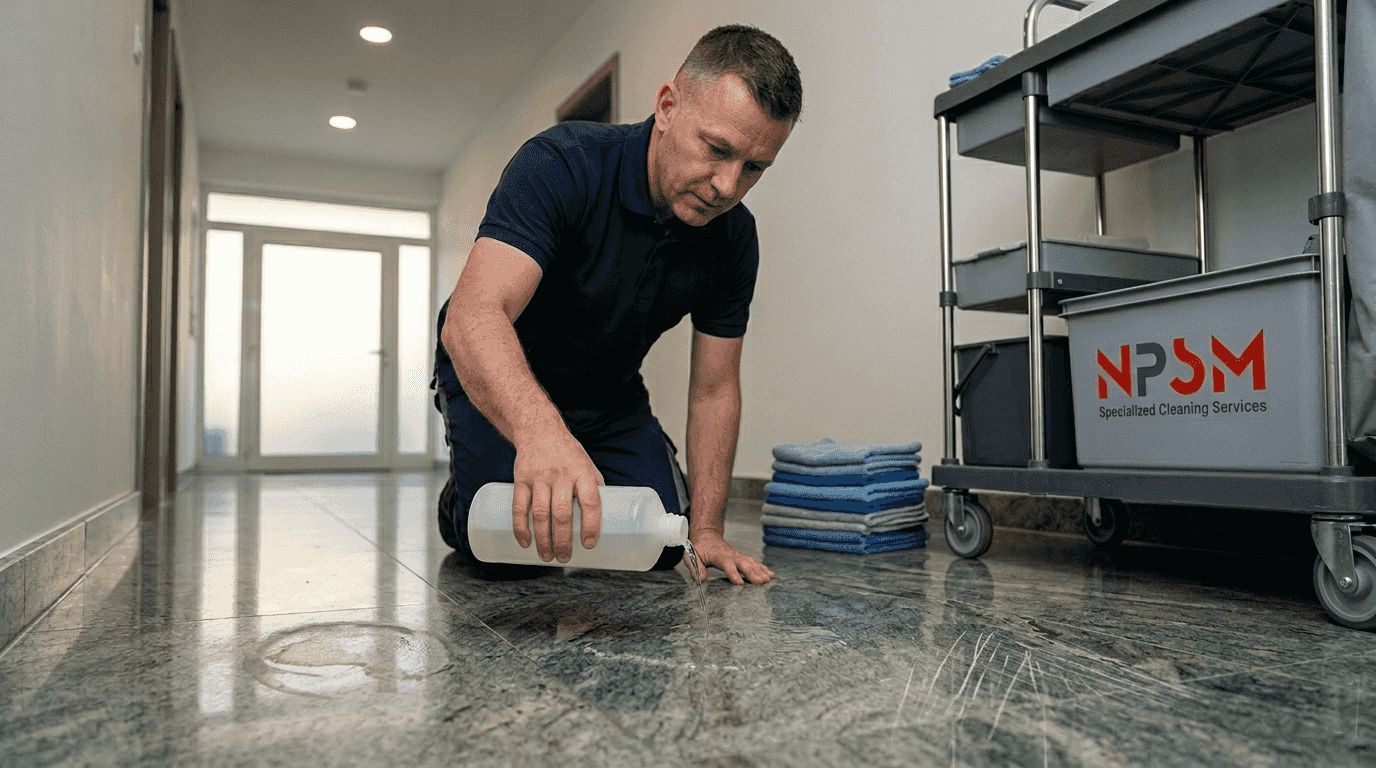
Wooden floor polishing methods use conditioning chemicals that fill micro-cracks and stabilize wood fibers. These treatments penetrate the grain structure, preventing moisture absorption and reducing expansion-contraction cycles. The chemicals create flexible bonds that move with the wood, unlike rigid mechanical coatings that crack over time.
The application protocol follows these steps:
- Comprehensive floor assessment to identify material type, existing damage, and chemical sensitivity
- Chemical selection based on material composition, current condition, and desired finish level
- Controlled application using precise concentrations and dwell times monitored by professionals
- Neutralization process to stop chemical reactions at optimal restoration points
- Protective sealing to lock in results and shield against future environmental damage
| Chemical Agent | Best For | Primary Action | Typical Results |
|---|---|---|---|
| Mild acid solutions | Marble, limestone | Dissolves oxidation, restores shine | Mirror-like finish in 24-48 hours |
| Alkaline oxidizers | Granite, natural stone | Breaks down organic deposits | Enhanced color depth, stain removal |
| Polymer conditioners | Wood floors | Fills micro-cracks, stabilizes fibers | Smooth surface, moisture resistance |
| Crystallization compounds | All stone types | Creates protective molecular layer | Long-term shine, scratch resistance |
Pro Tip: Temperature affects chemical reaction rates significantly. Professional services schedule treatments during cooler Dubai months (November through March) to ensure optimal chemical performance and drying conditions. Never attempt chemical polishing during summer heat when rapid evaporation prevents proper chemical penetration.
Advantages over mechanical polishing
Chemical polishing removes oxidation at the molecular level while mechanical methods only address surface irregularities. This fundamental difference explains why chemical treatments produce longer-lasting results. Mechanical buffing creates friction heat that can actually damage sensitive marble, while chemical reactions occur at ambient temperatures.
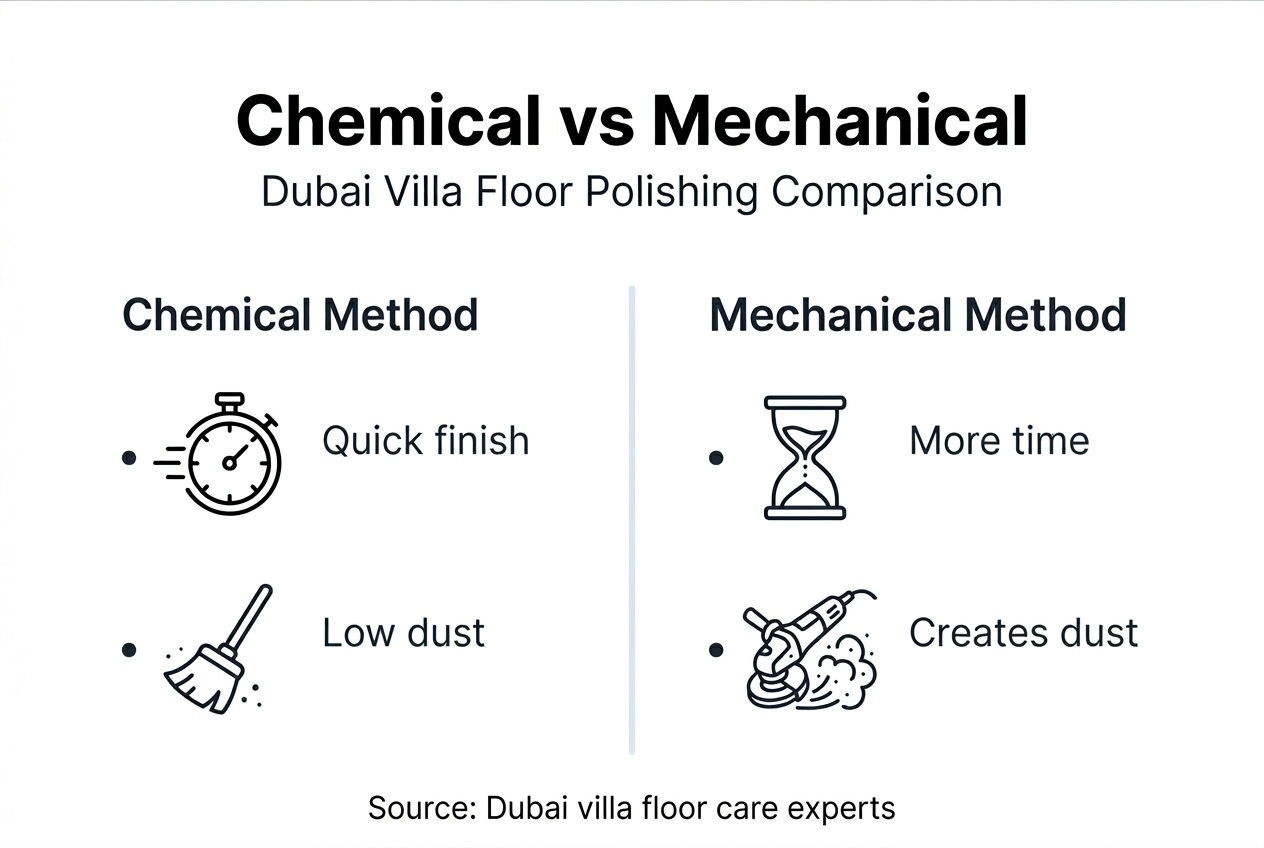
Time efficiency represents a major advantage. Chemical treatments typically complete in 6-8 hours for average villa floors, compared to 12-16 hours for mechanical polishing. The chemical process requires fewer passes and eliminates extensive setup for heavy equipment. Homeowners can resume normal activities sooner, reducing household disruption.
Chemical polishing improves slip resistance by creating microscopically textured surfaces that maintain grip without visible roughness. Mechanical polishing often creates overly smooth surfaces that become hazardous when wet. This safety benefit matters especially for families with children or elderly residents in Dubai villas.
Environmental impact favors chemical methods significantly. Traditional mechanical polishing generates substantial dust containing silica particles that pose respiratory risks. Chemical treatments produce minimal airborne particles and use water-based solutions with lower volatile organic compound emissions. Professional services use proper ventilation and containment to ensure household safety.
| Factor | Chemical Polishing | Mechanical Polishing |
|---|---|---|
| Treatment depth | Molecular level penetration | Surface abrasion only |
| Average duration | 6-8 hours | 12-16 hours |
| Dust generation | Minimal with proper technique | Substantial silica dust |
| Equipment noise | Low (pump and applicator sounds) | High (heavy buffing machines) |
| Maintenance interval | 2-3 years for marble | 1-2 years for marble |
| Slip resistance | Enhanced through micro-texturing | Often reduced by over-smoothing |
The extended maintenance intervals from wood floor polishing solutions provide substantial cost savings over time. Chemical treatments create protective barriers that resist daily wear, reducing how often you need professional services. Mechanical polishing removes microscopic amounts of material with each treatment, gradually thinning floors over decades.
Pro Tip: Chemical polishing preserves original floor thickness because it adds protective layers rather than removing material. This preservation becomes crucial for antique marble or rare wood species where maintaining original dimensions protects property value and historical authenticity.
Common misconceptions about chemical floor polishing
The belief that chemical polishing commonly damages floors stems from confusion between professional treatments and harsh DIY products. Professional-grade chemicals undergo rigorous safety testing and come with precise application protocols. Damage occurs when untrained individuals use incorrect concentrations or incompatible chemicals for specific floor types.
DIY attempts cause problems because retail chemical products lack the buffering agents and neutralizers that professionals use. Hardware store acids designed for concrete cleaning can etch marble permanently within minutes. Wood floor chemicals require specific pH ranges that vary by wood species, information rarely included on consumer product labels.
Safety protocols followed by certified professionals include:
- Comprehensive material testing before full application to verify chemical compatibility
- Continuous pH monitoring during treatment to prevent chemical overreaction
- Proper ventilation systems that exhaust fumes safely outside living spaces
- Personal protective equipment for technicians and household isolation procedures
- Emergency neutralization agents ready for immediate deployment if reactions exceed parameters
The misconception that chemical polishing is harsher than mechanical methods reverses the reality. Mechanical abrasion permanently removes floor material with each treatment, gradually thinning expensive marble and exotic hardwoods. Chemical treatments work with existing material, enhancing rather than removing it. Professional application prevents the etching and discoloration that give chemical methods an undeserved bad reputation.
“Homeowners should never attempt chemical floor polishing without professional training. The margin for error is extremely narrow, and mistakes cause damage that often costs more to repair than the original professional service would have cost.” – National Wood Flooring Association
Over 25% of reported floor damage cases in residential settings were linked to DIY chemical polishing attempts. These incidents involved incorrect product selection, improper application timing, or failure to neutralize chemicals properly. The financial and emotional cost of ruined luxury floors far exceeds the investment in qualified professional services.
Maintenance frequency and scheduling for Dubai floors
Dubai’s coastal climate accelerates floor wear compared to inland regions, requiring more frequent professional attention. Humidity levels averaging 60-70% during summer months cause marble to absorb moisture, creating surface cloudiness. Airborne sand particles act as constant abrasives, dulling finishes faster than normal foot traffic alone.
Recommended chemical polishing intervals:
- Marble floors: Every 2-3 years for living areas, annually for high-traffic entryways
- Granite floors: Every 2 years for kitchens and bathrooms, 3 years for bedrooms
- Wooden floors: Annual conditioning treatments combined with polishing every 18-24 months
- Natural stone floors: Every 2-3 years depending on porosity and exposure to moisture
Signs your floors need professional chemical polishing include persistent dullness despite regular cleaning, increased surface roughness that traps dirt, and stains that no longer respond to standard cleaning products. Water no longer beading on sealed surfaces indicates the protective layer has degraded and needs renewal.
Scheduling around Dubai’s seasonal conditions optimizes results. The ideal window runs from November through March when temperatures stay below 30°C and humidity drops. Chemical reactions proceed more predictably in moderate conditions, and faster drying times reduce household disruption. Avoid scheduling during June through September when extreme heat affects chemical performance.
Simple maintenance between professional treatments extends floor life and appearance. Sweep or vacuum daily to remove abrasive sand particles before they scratch surfaces. Use pH-neutral cleaners specifically formulated for your floor type. Place entry mats to capture sand and moisture before they reach interior floors. Avoid harsh chemicals or abrasive scrubbers that compromise protective sealants.
For comprehensive maintenance guidance, explore the floor maintenance tips blog and review the wooden floor maintenance guide for species-specific care instructions that preserve your investment between professional services.
Choosing the right professional chemical floor polishing service in Dubai
Selecting qualified professionals requires verifying specific credentials and asking detailed questions about their chemical polishing methods. Start by confirming they hold relevant certifications from industry organizations like the International Surface Fabricators Association or equivalent regional bodies. Experience specifically with chemical treatments matters more than general floor maintenance experience.
Verify they use environmentally safe, industry-approved chemicals with full disclosure of ingredients and safety data sheets. Reputable services explain which chemicals they’ll apply to your specific floor type and why those products work best. Red flags include vague descriptions like “proprietary formulas” without supporting documentation or reluctance to discuss chemical composition.
Customized floor assessments before service distinguish professional operations from generic contractors. Quality services include:
- On-site inspection to identify floor material, existing finish, and damage assessment
- Moisture testing for stone floors to detect subsurface water that affects chemical selection
- Small test applications in inconspicuous areas to verify chemical compatibility
- Written treatment plans explaining each step, chemicals used, and expected results
- Detailed timelines including application, drying, and when you can resume normal floor use
Ask about damage mitigation procedures and what happens if results don’t meet expectations. Professional services carry liability insurance and offer guarantees on their work. They should explain post-service care requirements and provide recommended maintenance schedules based on your specific floors and household traffic patterns.
Red flags signaling potentially unqualified services:
- Prices significantly below market rates suggesting shortcuts or inexperience
- No on-site assessment, offering quotes based only on square footage
- Inability to explain chemical processes or provide safety documentation
- No references from similar villa or apartment projects you can verify
- Pressure tactics pushing immediate service without allowing time for decision-making
Request references from recent projects involving similar floor types and verify them directly. Ask specifically about the service’s punctuality, cleanliness during work, and whether results matched promises. Check online reviews but focus on detailed accounts describing specific experiences rather than brief generic praise.
Explore floor restoration and polishing services and professional wooden floor polishing to understand comprehensive treatment options before making service commitments.
Summary and next steps
Chemical floor polishing restores and protects marble, granite, and wooden floors through molecular-level treatments that outperform mechanical methods. The process removes oxidation, fills micro-damage, and creates protective barriers against Dubai’s harsh coastal climate. Professional application ensures safety and optimal results while avoiding the significant damage risks associated with DIY attempts.
Maintaining regular polishing schedules based on material type and climate impact extends floor life dramatically. Marble requires attention every 2-3 years, granite every 2 years, and wood annually with conditioning treatments. These intervals prevent accumulated damage that becomes increasingly expensive to repair.
Professional services provide expertise in chemical selection, precise application techniques, and safety protocols that protect your family and property. The investment in qualified professionals pays returns through enhanced floor appearance, long-term protection, and maintained property values in Dubai’s competitive real estate market.
Schedule a professional floor assessment to understand your current floor condition and develop a customized maintenance plan. Experienced technicians identify specific issues and recommend treatment timing that fits your household schedule while optimizing chemical performance.
Take the next step toward preserving your villa or apartment floors by contacting trusted local polishing providers. Professional evaluation costs nothing and provides valuable insights into maintaining your property’s most visible and valuable surfaces. Visit floor polishing and restoration services to explore comprehensive solutions tailored for Dubai’s luxury residential market.
Professional chemical floor polishing services in Dubai
Specialized chemical polishing expertise for marble, granite, and wooden floors ensures Dubai villas and apartments maintain their luxury appearance and value. Professional services use environmentally friendly, industry-approved chemicals with customized treatments based on comprehensive floor assessments. Post-polishing care options extend results and protect your investment long-term.
Service benefits include:
- Enhanced floor appearance with mirror-like finishes that resist Dubai’s climate
- Long-term protection against humidity, sand abrasion, and salt damage
- Increased property value through maintained luxury finishes
- Safe application protocols protecting family health and household air quality
- Extended maintenance intervals reducing long-term floor care costs
Pro Tip: Request an on-site assessment before signing service agreements. Reputable providers offer free evaluations that identify your floor’s specific needs and provide detailed treatment proposals. This assessment protects you from unnecessary services while ensuring recommended treatments address your actual floor conditions.
Explore comprehensive floor polishing service Dubai options, specialized wooden floor polishing Dubai treatments, and natural stone polishing Dubai solutions designed specifically for luxury residential properties in the UAE.
What is chemical floor polishing and how does it work?
What is chemical floor polishing and which floors benefit most?
Chemical floor polishing uses specialized chemical agents to restore and protect floors at the molecular level by dissolving oxidation and creating protective barriers. Marble, granite, and wooden floors benefit most because these materials respond to chemical treatments that remove damage mechanical polishing cannot reach. The process works especially well for Dubai villas where coastal climate accelerates floor deterioration through humidity and airborne sand exposure.
How often should I chemically polish my villa’s marble or wooden floors in Dubai?
Marble floors need chemical polishing every 2-3 years for living areas and annually for high-traffic entryways exposed to sand and moisture. Wooden floors require annual conditioning treatments combined with polishing every 18-24 months to maintain protection against humidity. Dubai’s coastal climate accelerates wear compared to inland regions, requiring more frequent attention than international guidelines typically recommend.
Is chemical floor polishing safe for my family and the environment?
Professional chemical floor polishing is safe when certified technicians follow proper protocols including ventilation, pH monitoring, and approved chemicals. Services use water-based solutions with low volatile organic compounds and proper containment procedures. DIY attempts pose significant risks because retail products lack buffering agents and precise application instructions, potentially causing chemical exposure or permanent floor damage.
Can I do chemical floor polishing myself or should I hire a professional?
You should always hire certified professionals for chemical floor polishing because incorrect DIY attempts cause over 25% of residential floor damage cases. Professional services possess specialized knowledge about chemical concentrations, material-specific reactions, and safety protocols that prevent etching, discoloration, and health hazards. The cost of repairing DIY damage typically exceeds what professional services charge for proper treatment.
What questions should I ask a floor polishing service before hiring?
Ask for relevant certifications, full disclosure of chemicals they’ll use with safety data sheets, and whether they provide customized floor assessments before treatment. Request references from recent similar projects, details about their damage mitigation procedures, and written guarantees on results. Verify they carry liability insurance and will explain post-service care requirements specific to your floor types and household conditions.
Permalink
Permalink
Permalink